
LISTEN to the 15-minute podcast.
WATCH the 48-second video.
Rebuilding America’s transportation system and infrastructure remain a top-line concern. But managing higher project costs and improving road safety are at the forefront of states’ expansion efforts.
On the Central Coast of California, a national tragedy long ago pointed to the need to reconstruct more narrow rural roads and address potentially dangerous features.
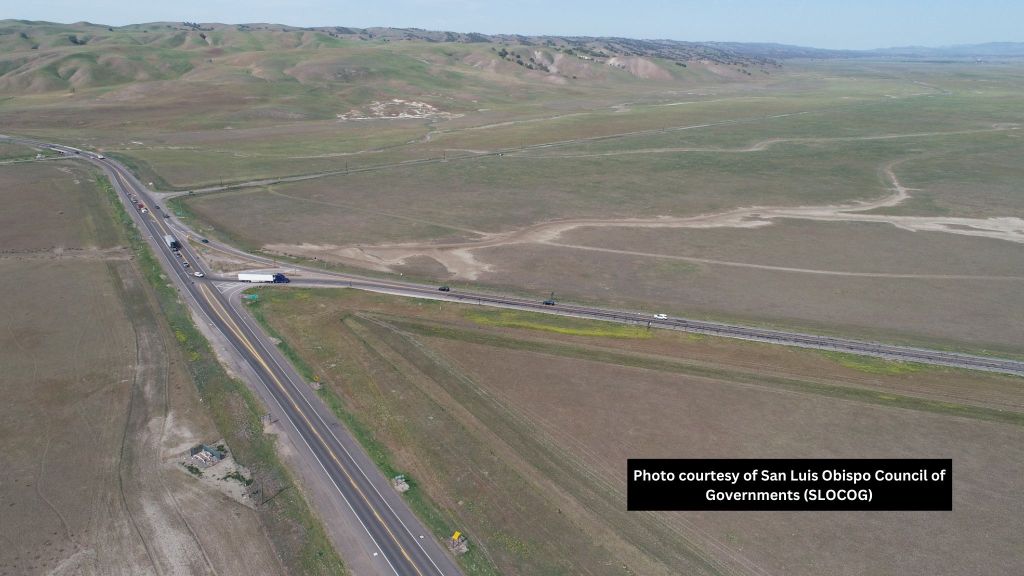
California’s push to improve portions of State Route 46, from a two-lane to a four-lane divided expressway, and save lives were in part propelled because of the death of actor James Dean 68 years ago on a stretch of road where his Porsche crashed.
Improving Safety Requires Local, State & Federal Funding
The 2021-passed bipartisan Infrastructure Investment and Jobs Act (IIJA) was a recognition that the status quo, of flatlined federal infrastructure investment and outdated transportation systems, cannot continue.
However, raising state funding and getting federal money to states and localities can be the more challenging part. Increased costs and delays can affect project programming. State and local officials must continually plan, advocate and identify funding to improve regional transportation networks.
“Safety and saving lives is what it’s all about,” says Paso Robles Councilmember Fred Strong in the latest No Time For Delays podcast. Paso Robles is located in San Luis Obispo County, a burgeoning region that links parts of the sprawling state.
Strong also represents Paso Robles on the National League of Cities (NLC), with six years on the Transportation & Infrastructure Policy Committee, including three years as Rail Subcommittee Chair and Co-Chair. He also has a litany of other roles, such as representing the city on the Board of Directors for the regional government, the San Luis Obispo Council of Governments (SLOCOG); representing SLOCOG on the board of LOSSAN, the Los Angeles-San Diego-San Luis Obispo rail corridor; and serving on the California Association of Council of Governments (CALCOG), with a focus on transportation and economic development.
Prioritizing Lives
Nearly $700 million has been invested to enhance the corridor. Along with local commuters, it has a large amount of through freight traffic. The route supports $7 billion in annual goods shipments, equaling more than a half of a million jobs, and the $5 billion Central Coast tourism industry.
Strong explains that improvements encompass road-design characteristics such as at-grade crossings (level crossings where visibility is reduced), turns, areas where roads meet or veer off, and more modern engineering and construction.
The Corridor Project’s purpose, according to the California Department of Transportation (Caltrans), is to minimize fatal accidents, and reduce existing and future peak hour congestion on 46 between Paso Robles and Cholame, a crucial east-west corridor linking the Central Coast and Central Valley areas of California. State Route 46 is one of the few such routes connecting Interstate 5 to U.S. Highway 101.
Included in these efforts is completion of the Cholame Section and what is known as the Wye Interchange, which is at the intersection of state routes 46 and 41. Decades since Dean died, it remains a segment with a dated configuration where there has been a higher-than-average rate of collisions. But since the project was first programmed, “material(s), trucking fuel cost and other raw materials have escalated up to 50 percent in certain sectors,” according to SLOCOG.
“The California Transportation Commission (CTC) stuck its neck out for us and really maximized results” by approving an additional $60 million in Interregional Transportation Improvement Program (ITIP) funding in December 2022, adds SLOCOG Regional Transportation Planner John DiNunzio.
In March, through the state’s Federal Transportation Improvement Program (FTIP) and SLOCOG efforts, that interchange will be rebuilt and widened. Federal dollars come in the form of a range of grants and/or formulaic funding that include state matches.
The federal contribution for combined construction capital and inspection support is about $101 million of a capital and support total cost of over $171 million, according to Project Manager Nicholas Heisdorf.
Local Leaders Eyeing IIJA Dollars
Road improvements are not just being pursued by the state, however. Thirty miles from the Dean site, there is a city undertaking for a 46 overcrossing at Airport Road (for Paso Robles Airport) to remove local traffic from 46 and eliminate commercial trucks turning left across a four-lane expressway. Trucks “have a difficult time slowing down slope of the westbound grade” and T-bone collisions are a problem, the city reports.
Paso Robles has applied for $40 million in a Trade Corridor Enhancement Program Grant. It also works with a lobbying firm to advocate for IIJA funding for this Golden Spike Project.
Strong says it’s a proactive move to improve safety through planned grade-separated improvements at the intersection of Union Road (a local road) and 46. He thinks the project will cost around $90 million, with the majority being for the highway overcrossing and the remainder for bridging a creek.
“Since the Eisenhower Administration, when the Interstate [Highway] process was started, we have never spent enough since then, until this last legislation, to take care of even 10 percent of the needs. And so we’ve been disintegrating gradually for over 40 years. Now, this is a big chunk of money. It still isn’t 100 percent, but that’s because we’ve fallen so far behind. But if we can hold that pace going forward, we can probably get back on track within a decade or two.”
Under the IIJA, the San Luis Obispo County region, including seven cities, will have an increase of five-year revenue projections of 30- to 40 percent. This includes bridges, road maintenance, transit, and the area’s surface transportation program.
Stay current on how American communities benefit from federal investment in infrastructure. Subscribe to our e-mail newsletter and follow us on social media.
 No Time For Delays