
By Debra Zimmerman Murphey, Vice President of Content Development at Tobin Communications, Inc.
WATCH the 2-minute video.
On March 26, 2024, the Dali cargo ship hit one of the longest continuous steel truss bridges in the United States. There was a collective world pause when and after Baltimore’s Francis Scott Memorial Key Bridge collapsed.
The accident resulted in the deaths of six immigrant construction workers, a trapped crew, lawsuits, traffic problems, delays in exports and imports, and longer-term community impacts. It is a persistent indicator of how important infrastructure is to the public and regional and national economies.
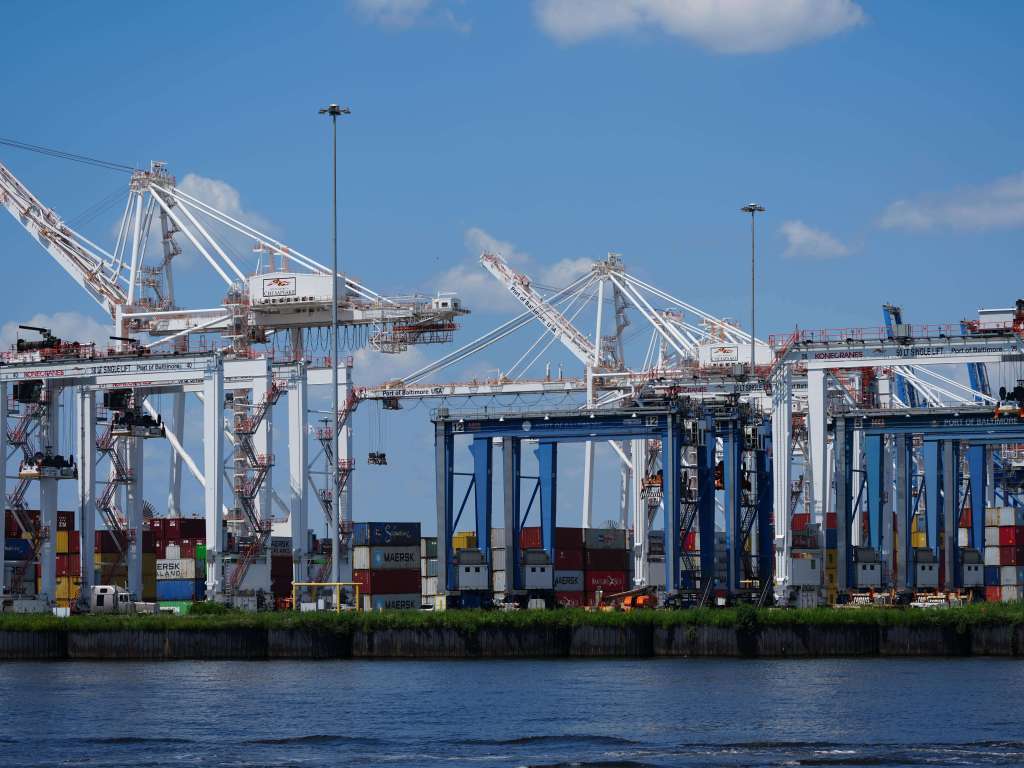
In 2023, the Port of Baltimore handled about 52 million tons of international cargo valued at $81 billion. Nationally, Baltimore ranks ninth for both total dollar value and tonnage of international cargo, according to Adam Scavette of the Federal Reserve Bank of Richmond.
Twenty-eight percent of all U.S. coal exports were transported through the Port of Baltimore, according to the National Taxpayers Union (NTU). It is the 10th-largest port for dry bulk commodities such as coal and grain. It is also a primary port for automobiles and farm equipment.
CBS News reported that the bridge, based on recent analyses, would have been among the top-10 most at-risk bridges in America. It is estimated that the rebuild, which will be federally funded, could cost over $5 billion and be finished in 2028.
“Businesses that employ an awful lot of well-paid middle-class craft workers in this country stand to benefit from this project,” said Brian Turmail, VP of Public Affairs for the Associated General Contractors of America (AGC), in a recent interview for No Time For Delays with Tobin Communications, Inc. (TCI). “Remember that the men and women who are going to be building this bridge include a large number of men and women who voted for President Trump.”
But recently, Maryland Gov. Wes Moore and President Donald Trump were in a verbal clash over the possibility of deploying National Guard troops to Baltimore. Trump then threatened to cut off federal money to construct the new bridge — a missing connector that impacted the lives of nearly half of Baltimore-area residents, according to a study released several months ago by Johns Hopkins University.
“The bridge funding doesn’t come from the president. It comes from Congress,” Moore told WBAL-TV. “Congress authorized the capital, so Congress is the only [one] with the authority to pull it away.”
Bipartisan Funding Boost
In 2021, Congress passed a bipartisan infrastructure bill known as the Bipartisan Infrastructure Law (BIL) or the Infrastructure Investment and Jobs Act (IIJA). A total of $1.2 trillion was allocated, with the legislation expiring next year.
A major push for a new bill has yet to emerge.
The IIJA policy framework was heralded as a renaissance to transition the nation’s infrastructure from tired and crumbling to new and resilient. Many of these projects are funded through categorical federal grants. The bill also significantly invested in projects for tribal nations, a promising area of focus.
Interestingly, this year — several years after that bipartisan law was enacted — the American Society of Civil Engineers (ASCE) noted an uptick in its overall grade of C regarding the U.S.’s infrastructure when contrasted with its grade of C- in 2021.
It is the best grade ASCE has given to the country since it began its Report Card (released every four years) in 1998, wrote Matt Fogleson. Eight categories had improved grades, seven the same grade, and two had lower grades. The graded sectors that improved in the 2025 report card were dams (D to D+), hazardous waste (D+ to C), inland waterways (D+ to C-), levees (D to D+), ports (B- to B), public parks (D+ to C-), roads (D to D+), and transit (D- to D).
A Start Toward Being an Infrastructure Leader
America’s broad interconnected road system took root when President Dwight D. Eisenhower signed the Federal Aid Highway Act of 1956. This was an era in which it was impossible to envision that safe and good transportation infrastructure wouldn’t be viewed as bipartisan issues. Eventually the Highway Trust Fund was established which drew revenue from the federal gas tax.
The idea that the U.S. needs a modern and efficient multimodal network, and that it needs maintenance, new embedded technologies, and replacement projects has, historically, been a nonpartisan issue. Over decades, there have been numerous multi-year infrastructure funding bills.
Comparatively, the potential for infrastructure projects and funding to be used as a political cudgel now is clear. A fragmented policy arena, and social media and 24/7 news cycles, feed into this polemic tumult.
And while infrastructure underinvestment remains a constant concern for states, and the labor and business sectors, costs have risen significantly. The American Enterprise Institute (AEI) points out that getting projects off the ground is affected by lengthy environmental reviews.
Last month, however, the Eno Center for Transportation took a deep dive into why highway construction costs continue to rise. It cited “factors such as supply chain disruptions, materials and inputs costs, labor market shortages, demand side increases, number of bidders on projects, state capacity and reliance on consultants, borrowing costs, regulatory costs, and higher-quality projects.”
Why Is Infrastructure Affected?
Experts say infrastructure ranges from parks and schools, to transit, bridges and roads, and to ports, dams, airports, broadband, clean water, and alternative energy sources. Concerning the latter, the Trump administration has pursued policy shifts to negate theories of climate change being impacted by humans, and to throttle greener energy priorities.
Additionally, America is dealing, in many cases, with roads that are many decades old and bridges, structures, and rail and waterway systems created over a century ago. Many of these can and will be affected by more intense weather events.
The U.S. sustained 403 weather and climate disasters from 1980–2024. The total cost of these 403 events exceeds $2.915 trillion, according to the National Centers for Environmental Information of the National Oceanic and Atmospheric Administration (NOAA).
Infrastructure isn’t just about moving domestic or foreign goods. It is about program sustainability, safety and interstate commerce. It is about reliable jobs. It is about being malleable and responsive, supporting tourism, and making sure communities function and people can get to where they need to for business interactions, school, work, pleasure, family responsibilities, and healthcare.
America’s infrastructure is not only a domestic issue. Investors, markets, world and industry leaders, and other countries follow its progress. New Delhi’s Indian Express reported this summer about watershed projects in America meant to “reshape” infrastructure.
Among those mentioned were: Seattle-Tacoma’s $54 billion Sound Transit 3’s light rail expansion; Dallas-Houston’s private $41.6 billion high speed railway endeavor (based on Japanese technology); New York’s $19 billion JFK Airport Expansion; New Mexico-Arizona’s $11 billion SunZia Wind and Transmission renewable energy project; and Los Angeles’ $9.5 billion Metro D Line Extension.
The list of infrastructure endeavors will always be long because of the necessity to move goods and people and the economy forward. Click here to see IIJA project funding and USDOT grants that were announced earlier this year.
Stay current on how American communities benefit from federal investment in infrastructure. Subscribe to our e-mail newsletter and follow us on social media.
 No Time For Delays